Guides · 6 min read
14k Gold-Filled vs. Solid Gold vs. Gold Plated: What to Choose for Permanent Jewelry
By Alexis ·
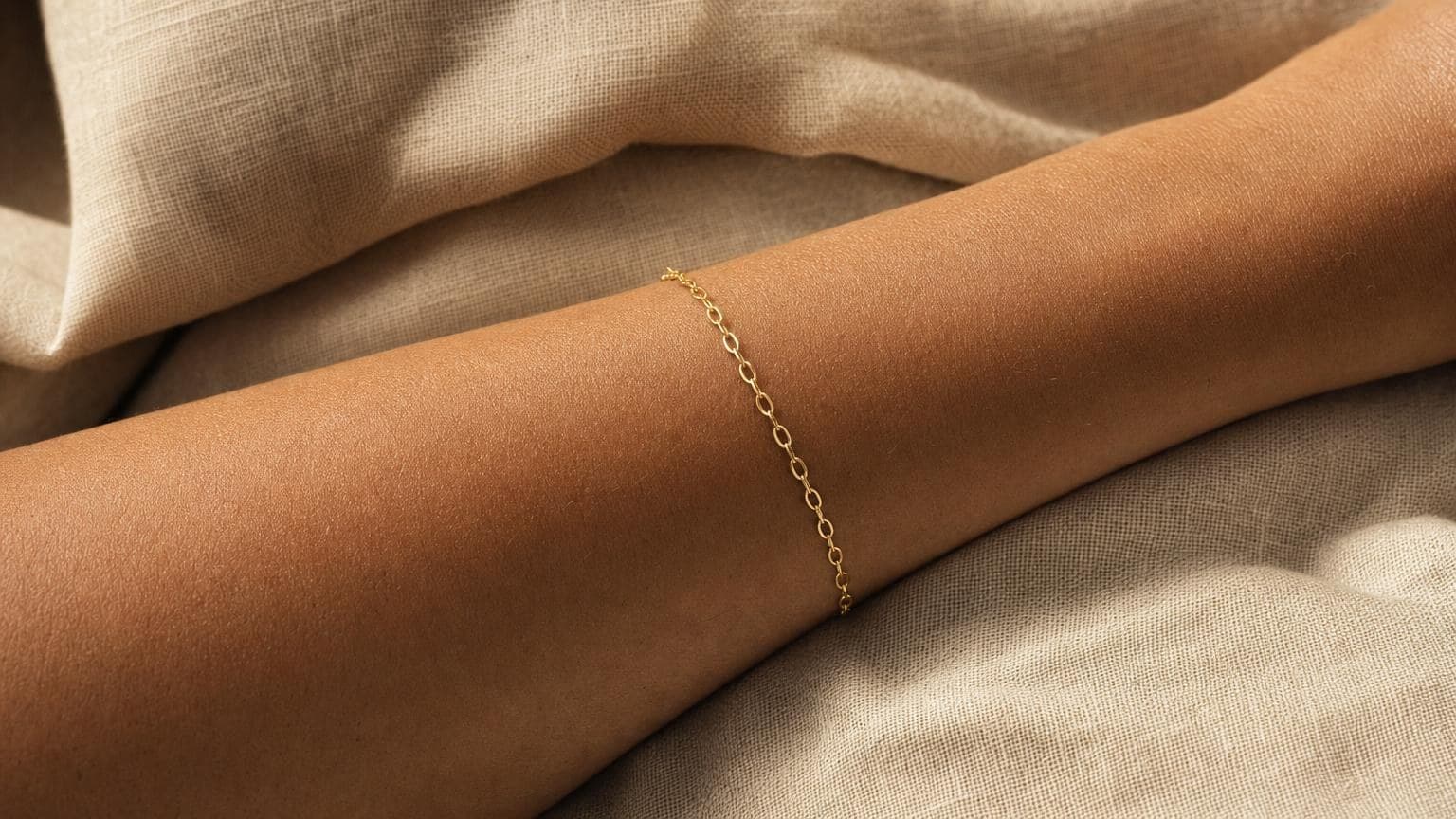
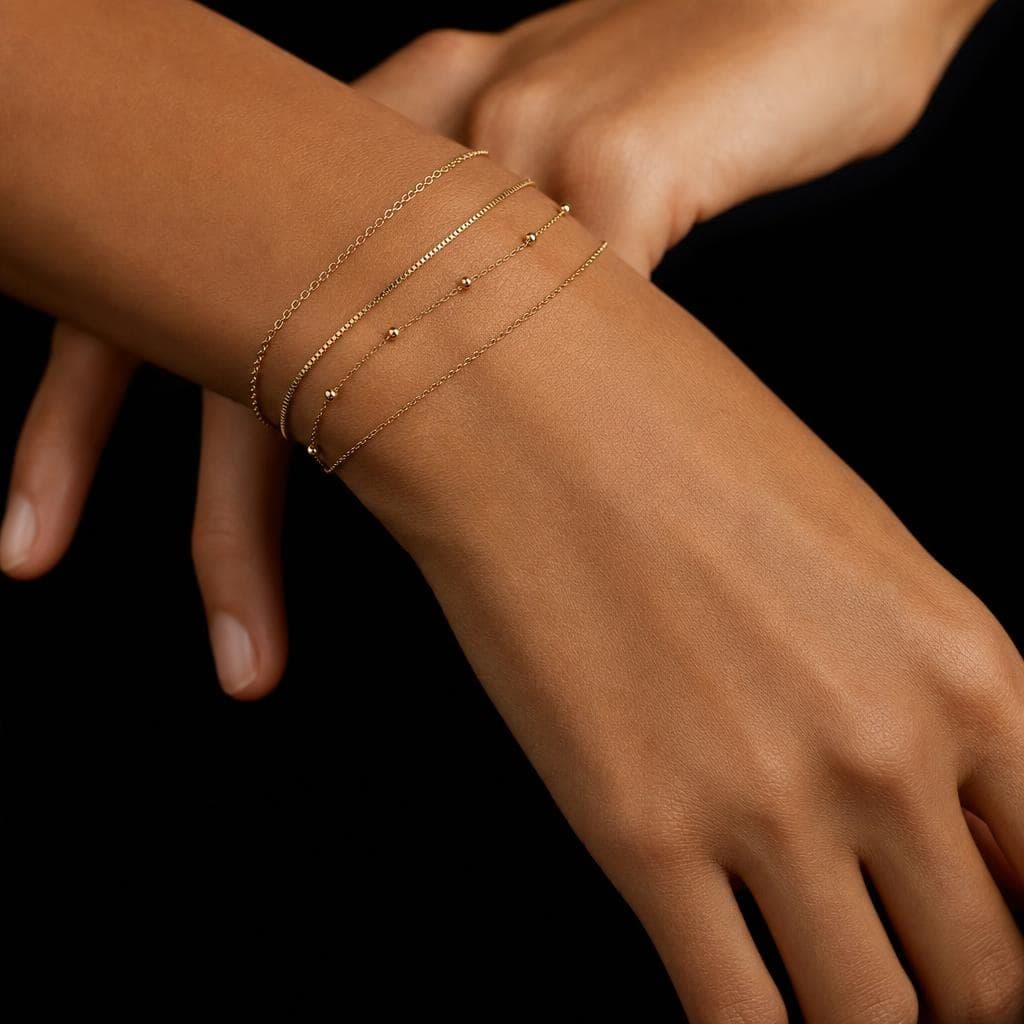
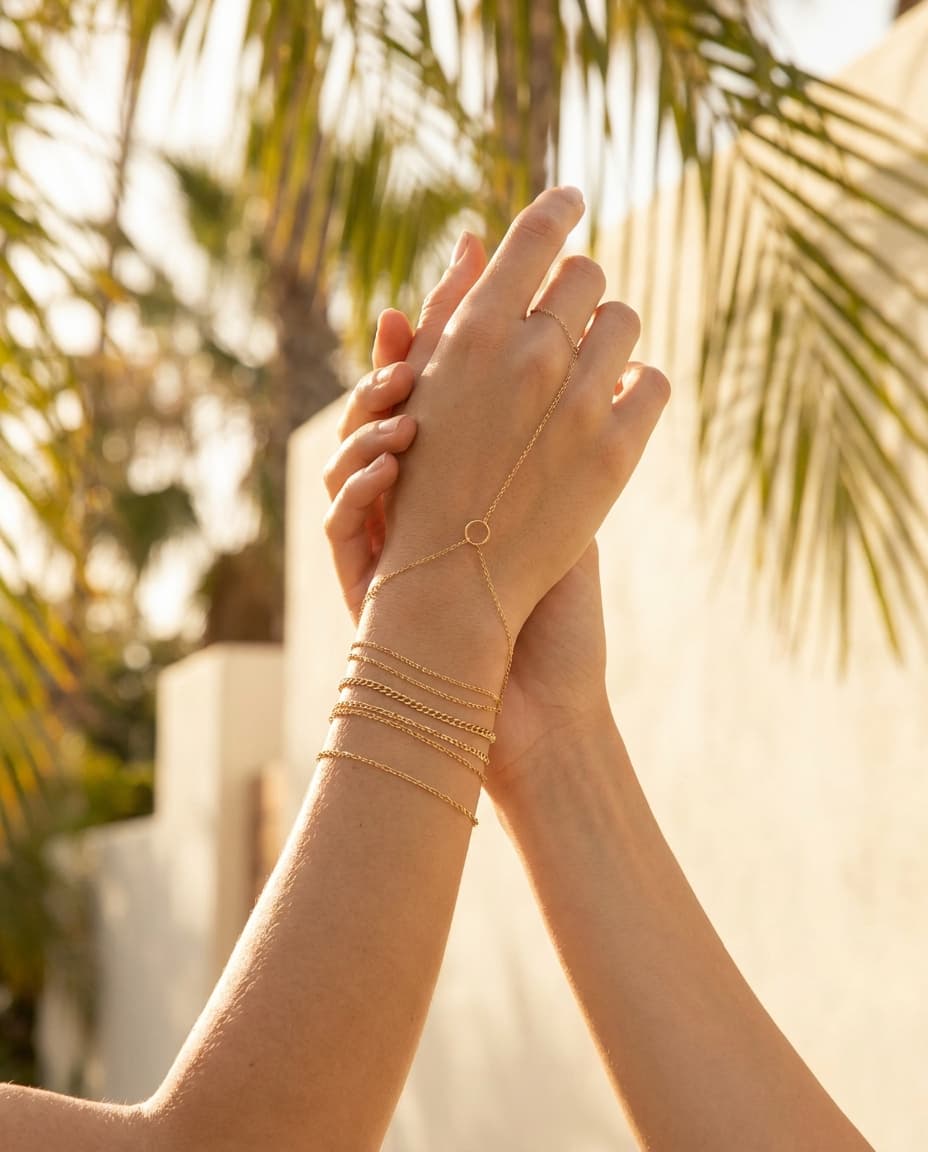
Gold jewelry comes in three very different grades, and the labels blur together fast: solid gold, gold-filled, gold plated. On day one they can look identical. What separates them is how much gold there is and where it sits, and for a chain that gets welded on and never taken off, that matters more than it does for earrings you wear on Saturdays. For the record, Bond & Fifth welds sterling silver and 14k gold-filled. Here's why, and how to tell the three apart wherever you shop.
The short answer
Solid 14k gold is 14k gold alloy all the way through. 14k gold-filled is a thick layer of 14k gold bonded over a base-metal core, at least 1/20 of the metal's weight. Gold plated is a thin surface layer, measured in microns. For permanent jewelry, gold-filled gives you real gold on the surface at an everyday price.
All three, side by side
| Solid 14k gold | 14k gold-filled | Gold plated | |
|---|---|---|---|
| What it is | 14k gold alloy all the way through | A 14k gold layer mechanically bonded over a base-metal core, usually brass | A thin layer of gold deposited on another metal by a chemical or electroplating process |
| How much gold | 14 parts gold in 24, about 58.3%, throughout | The 14k layer is at least 1/20 of the metal's weight | The FTC minimum for gold electroplate is 0.175 microns thick |
| What can wear | No layer to wear through | Much thicker than plating, though the layer can eventually wear through | How long it lasts depends on how thick the plating is |
| Typical stamp | 14K or 585 | 1/20 14K GF | Karat plus G.E.P., such as 12K G.E.P. |
| At Bond & Fifth | Not on our menu | Yes: bracelet $85, anklet $105, necklace $135, welding included | We don't weld plated chains |
Solid 14k gold
Karat measures gold in parts per 24, so 14k is 14 parts gold and 10 parts other metals, about 58.3% gold. Under the FTC's Jewelry Guides, a piece marked "14K" has to be that alloy all the way through, and a hollow piece shouldn't be sold as "solid". Because there is no layer, there's nothing to wear through. The trade-off is the gold itself: a solid chain uses far more of it than a gold-filled chain the same size, and it's priced that way.
14k gold-filled
Gold-filled is a real layer of karat gold bonded to a base-metal core, typically brass, by mechanical means rather than electroplating. The FTC only allows the term when that layer is at least 1/20 of the weight of the metal, which is why you'll see stamps like "1/20 14K GF". There's a lighter grade too: at 1/40, the same construction has to be called rolled gold plate. Gold-filled's layer is much thicker than standard plating, and that's why it's the gold we weld.
Gold plated, and vermeil
Gold plating is a thin layer of gold deposited on another metal by a chemical or electroplating process. The FTC's minimum for gold electroplate is 0.175 microns, and "heavy gold electroplate" starts at 2.5 microns. Gold-plated sterling silver with at least 2.5 microns of 10k or better gold can be sold as vermeil. Plating has its place, but how long it lasts depends on its thickness, and on silver the gold can slowly fade as silver diffuses into it.
How to read the stamp
Stamps are tiny, but they're regulated. Here's what the common ones mean under the FTC's guides:
- 14K or 585: 14k gold alloy all the way through.
- 1/20 14K GF: 14k gold-filled, with the gold layer at the FTC's gold-filled minimum of one twentieth of the metal's weight.
- 1/40 14K RGP: rolled gold plate, the same construction at half the gold-filled minimum.
- A karat plus G.E.P., like 12K G.E.P.: gold electroplate, a thin plated layer.
- 925 or Sterling on a gold-colored piece: gold over sterling silver, so ask how thick the gold is.
Which makes sense for permanent jewelry?
A welded chain lives on you around the clock: in the shower, the ocean, the gym and your sleep. You can't take it off to protect it, so what matters is how much gold is on the surface and what's underneath.
- Choose 14k gold-filled if you want the look of 14k gold, with real gold on the surface, at an everyday price. At Bond & Fifth a bracelet is $85, welding included.
- Choose solid 14k if you want gold all the way through and the budget allows. It isn't on our menu, so this one is a conversation for a fine jeweler.
- Skip plated for anything welded on. It's thin by design, and a permanent chain never gets a day off.
- Prefer silver? Sterling silver is silver all the way through, from $75 for a bracelet, and we compared it with gold-filled in detail.
Common questions
Is 14k gold-filled real gold?
Yes, on the surface. The outer layer is real 14k gold alloy, and under FTC rules it must be at least 1/20 of the metal's weight. Underneath is a base-metal core, typically brass. It isn't solid gold, and a reputable seller won't call it that.
Is gold-filled better than gold plated?
For something you wear every day, generally yes. Gold-filled's layer is bonded mechanically and must be at least 1/20 of the metal's weight; plating is a thin deposited layer with an FTC minimum of 0.175 microns. The gold on gold-filled is much thicker, and that's what you're paying for.
Is solid gold worth it for permanent jewelry?
It can be, if you want gold all the way through and don't mind paying for it. Keep in mind that a permanent chain gets snagged now and then and may need snipping off for an MRI. We think 14k gold-filled is the better balance for a piece you never take off, which is why it's the gold we weld.
Does Bond & Fifth weld solid gold?
No. We weld two metals: sterling silver, with bracelets from $75, and 14k gold-filled, with bracelets from $85, welding included. Find us at a pop-up, or book a private event and we'll bring the whole setup to you.
What does 1/20 14K GF mean?
It's the standard gold-filled stamp. 14K is the karat of the gold layer, GF means gold-filled, and 1/20 means the gold layer makes up one twentieth of the weight of the metal, the FTC's minimum for calling something gold-filled.
Sources & further reading
Want to see gold-filled and sterling side by side on your own wrist? Come find us at a pop-up, or have us bring the whole chain bar to your party.
Keep exploring